Choose area:

Samsung Signs MOA to Launch SIC Programme at Durban University of Technology

Samsung recently signed a memorandum of agreement (MOA) and officially launched the Samsung Innovation Campus (SIC) programme at the Durban University of Technology, in an effort to establish a strategic partnership that is able to equip the next generation with future-ready technology skills to enhance student employability.
The MOA signing ceremony and the official launch of the SIC programme took place recently at Coastlands Musgrave Hotel and in attendance were some key dignitaries and partners that included Samsung's Public Affairs team; Nhlakanipho Nkontwana – the head of department (HOD) for the KwaZulu-Natal (KZN) Department of Economic Development, Tourism and Environmental Affairs (EDTEA); as well as Prof Pfano Mashau – the director of Durban University of Technology (DUT) Business School along with the members of the institution’s leadership team.
Recent data from Statistics South Africa has shown that youth unemployment in South Africa stands at over 46% among people aged 15 to 34. Yet, the technology sector is struggling to find talent. Also, a comprehensive 2024/2025 research report titled: “Decoding ICT Demand”, conducted by The Collective X, has revealed that over 118,000 digital and ICT jobs in South Africa remain unfilled, including thousands of entry-level roles suitable for young professionals starting their careers, and this is a clear indication of a skills gap in the country.
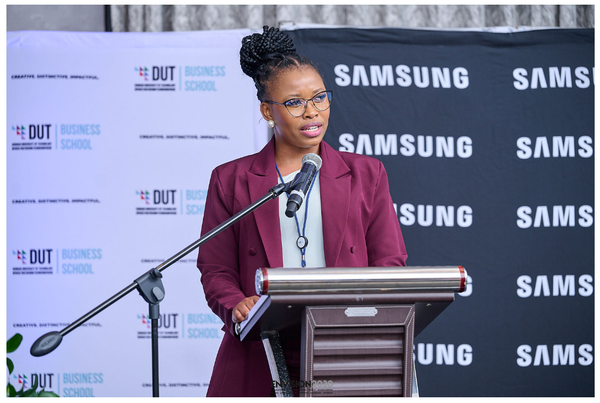
The SIC programme, hosted within the DUT Business School, aims to upskill 60 young people in fourth industrial revolution (4IR) technologies by providing training in high-demand fields, including coding and programming (C&P) in Python, as well as artificial intelligence (AI). Importantly, this programme will now also enable DUT students to move beyond job seeking and become entrepreneurs in technology, capable of developing AI-driven projects and solving real-world problems.
Speaking at the signing ceremony, Lefa Makgato, CSR Manager for Samsung South Africa, outlined how over the next three years, Samsung will be investing a significant amount annually to support this initiative, ensuring that the SIC programme is not just a training programme but an investment in South Africa's digital future. For Samsung, this strategic collaboration with both DUT and the KZN government is rooted in a shared belief that education, technology and teamwork are key to building a more inclusive society.
She also emphasised the need for this SIC programme to bridge the divide between academic learning and industry requirements, ensuring graduates possess the practical skills needed to secure jobs in the tech sector. Ultimately, by fostering digital literacy and job creation, the collaboration between these strategic partners, as well as Samsung’s objectives, align with the country’s National Development Plan (NDP) 2030.
The DUT curriculum, which fits perfectly with the objectives of the SIC programme, also aims to teach students important soft skills that include communication, critical thinking, problem solving and the ability to collaborate with others. This SIC programme is not only equips students with vital skills that are required in work environments but also those that will help them solve real-world challenges.
According to DUT, with the advent of 4IR, society has become more connected than ever, thereby increasing the need for graduates with varied skills to drive technological innovations that address societal and industrial challenges. DUT’s inspiring launch has therefore managed to bring together industry and academia to unlock opportunities, accelerate digital skills and shape the next generation of leaders.
Prof Pfano Mashau (DUT) emphasised: “As DUT, we know that our role in this collaboration is to ensure that our curriculum equips our young people with skills that will help them to become employable. We are therefore very grateful to Samsung for this partnership that is allowing us to contribute to the skills development of our young people in KZN. We hope that at the end of this SIC programme, our unemployed graduates will use the in-demand skills they acquire from this initiative to start their own businesses as well as empower themselves even further.”
This newly formed Public–Private Partnership (PPP) is now acting as a catalyst for youth empowerment – highlighting how successful collaborations such as the one between DUT, government and the private sector can help address youth unemployment and skills shortages in the country.
The partners, along with their government counterparts, believe that this SIC programme is not only nurturing technology skills, but it is also developing a generation of technological innovators and problem solvers. The beneficiaries from this programme carry a great responsibility as they are not merely beneficiaries, but also pioneers that will shape how technology serves communities, now into the future.
Nhlakanipho Nkontwana - HOD for the KwaZulu-Natal EDTEA explained: “The launch was more than a ceremony, it represented a moment to re-imagine education in an era defined by rapid technological advancement, particularly the rise of AI. These days,” he added, “AI is allowing us the opportunity to not only equip students with qualifications, but also with adaptable future-building competencies.”
“Importantly, partnerships such as the one we are celebrating between Samsung Africa and DUT Business School are essential in achieving the country’s educational goals. This collaboration is both timely and strategic - it brings together academic excellence and industry expertise, creating a bridge between theory and practice as well as a link between lecture halls and the real world. Through this partnership, students will not only gain exposure to cutting-edge technologies but also develop the practical skills required to navigate and shape the digital economy,” concluded Nkontwana.
Supplied by: Samsung.
Guzzle Media
THIS WEEK'S TOP STORIES

Samsung opens pre-orders for its most versatile Galaxy foldable line-up yet

CapeGate sets the stage for a high-stakes MTN SHIFT Gaming weekend

HUAWEI Pura 90s Series launches in South Africa with next-generation AI photography